Motorcycle Stored for Winter: Suspend or Keep Insurance?
November has arrived, salt covers the roads, and your bike is about to sleep under a cover until spring. Should you suspend your motorcycle insurance or keep part of it during winter? The answer depends on your contract, where the vehicle is stored, and your financing. Here’s how to sort it out, whether you ride a street motorcycle or a city scooter.
A motorcycle that doesn’t run can still suffer damage
People often think an immobile vehicle faces no risk. That’s a common mistake. For five or six months, your motorcycle remains exposed to events that have nothing to do with riding: a garage fire, theft, water damage, a fallen object, or vandalism.
These risks are often covered by the “damage other than collision” portion of the contract, sometimes called all-risk coverage except collision or storage risk protection. This portion is exactly what you want to keep when you put the motorcycle into hibernation.
- Fire caused by a heater, electrical outlet, or neighboring garage user
- Theft of the entire motorcycle or parts (wheels, fairing, battery)
- Water damage from a roof, basement, or water heater
- Damage caused by rodents to wiring and seat padding
- Snow load falling on a shed or temporary shelter
Three possible scenarios for winter
Most motorcyclists find themselves in one of these three situations. Exact options vary from insurer to insurer, so read your contract and ask the question before your renewal or change date.
Keep coverage as-is
This is the simplest route. You don’t change anything, and the motorcycle stays protected in case you take it out on a nice December day. In exchange, you pay for protections you probably won’t use, like liability coverage while riding.
Switch to reduced coverage during storage
Many insurers allow you to keep only theft, fire, and vandalism protection, without liability or collision coverage. The premium then decreases—as a rough estimate—by a variable portion depending on your profile and contract. Check if the endorsement must be requested in advance and if you can lift it quickly in spring.
Cancel completely: the scenario to avoid
Without any protection, a claim while in storage leaves you facing the loss alone. A lender may also require proof of continuous insurance for a financed motorcycle. Finally, a gap in your insurance history can, depending on the insurer, affect the premium when you restart coverage. Always ask how suspension is treated in your file.
Where are you storing the motorcycle? Location makes a difference
A garage attached to your home, a shed in your yard, a rented storage unit, or the parking lot of a condo building don’t present the same risk. The insurer may ask where the vehicle will be stored, especially if you’re switching to reduced coverage. Inaccurate information could complicate a claim.
Another common pitfall: thinking home insurance covers your motorcycle because it’s in the garage. Motorized vehicles are generally excluded from a home insurance contract, even when stored. The contents of the garage may be protected within certain limits. To understand this boundary, check our page on home insurance or discuss it with your adviser before winter.
- Heated or unheated garage: mention it if asked
- Rented storage or locker: check owner requirements and security measures
- At a relative’s: provide the storage address if it differs from yours
- Trailer or temporary canvas shelter: ask if they’re accepted as a storage location
Scooter: moped or motorcycle?
The scooter deserves a separate note. Depending on its engine displacement and top speed, it may be classified as a moped or motorcycle, with different requirements for license, registration, and insurance. Before deciding what to do for winter, confirm your vehicle’s category with the SAAQ and your insurer.
Some city dwellers would like to ride year-round. However, ice, salt, and low temperatures make two-wheeled riding risky and demanding on the engine. If you’re tempted by an occasional winter outing, keep full riding coverage rather than discovering at the moment of an accident that you’d reduced your protection.
Also think about accessories: rear trunk, windscreen, helmet, and technical clothing. They’re not always automatically included, so check their coverage limits.
Business owners: delivery scooter and service motorcycle
A business using a scooter for deliveries, a technician commuting by motorcycle, or a tradesperson who rides mostly in summer has a particular situation. The declared use to your insurer must reflect reality. A vehicle used for work isn’t insured like a recreational one, and inaccurate disclosure can jeopardize a claim.
When activity slows in winter, ask how your contract handles seasonal breaks. Also consider what you transport: merchandise, insulated bags, tools. This content is rarely covered by a motorcycle contract and may depend on separate protection. A quick look at business insurance shows where one protection ends and another begins.
- Specify if employees drive the vehicle in addition to the owner
- Indicate the type of delivery (food, parcels, materials) and average distance
- Ask how transported merchandise is covered, if applicable
- Keep records of storage and restart dates
Preparing for storage and restart
Good preparation reduces the risk of a claim and facilitates any potential recovery. Take photos of the motorcycle, note the serial number, and keep receipts for accessories or modifications. These documents prove the vehicle’s value if theft or fire occurs.
In spring, the trap is the first nice day in March. If you’ve suspended certain protections, restore full coverage before you take to the road, not after. Written confirmation of the restart date prevents nasty surprises.
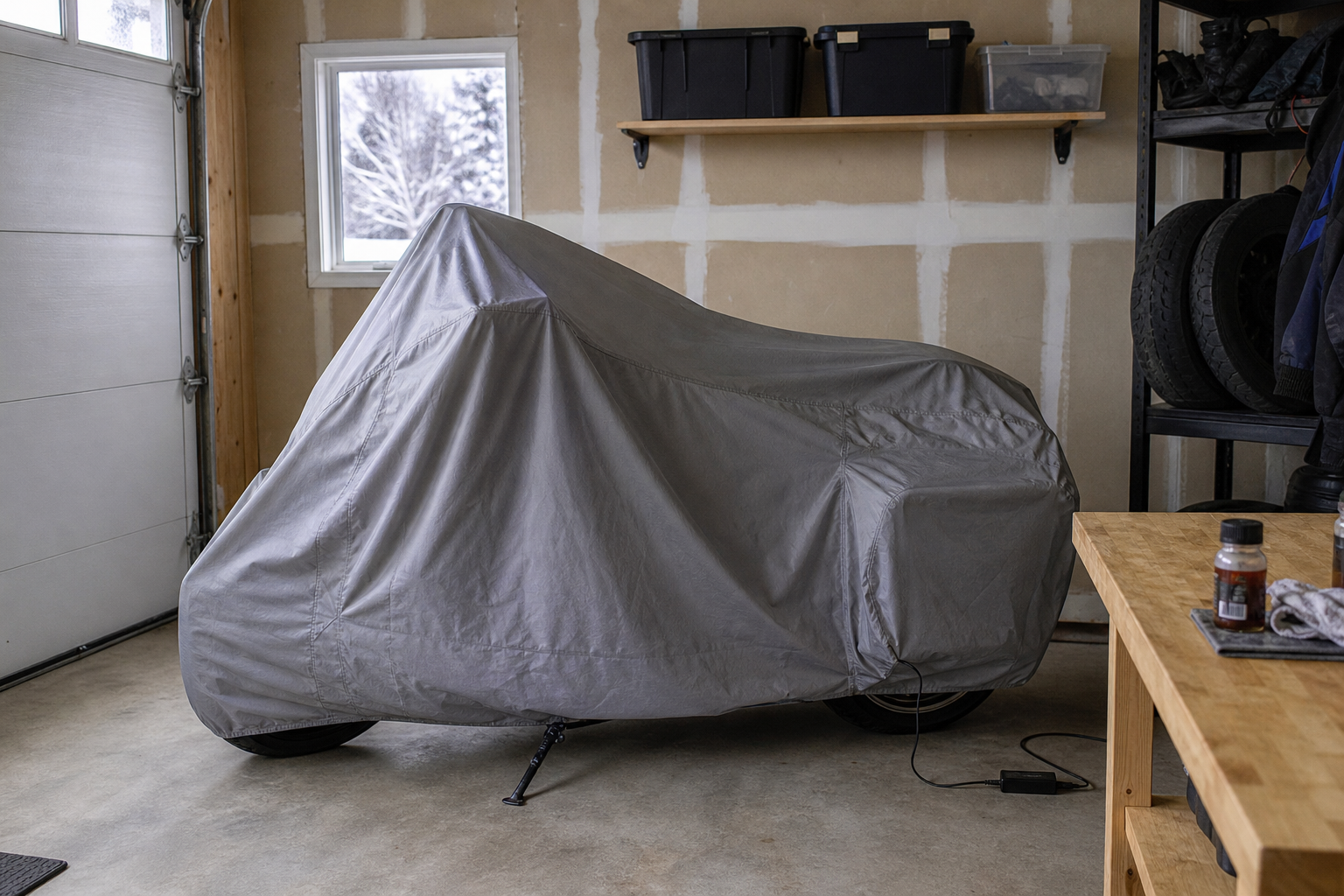
- Battery disconnected or connected to a trickle charger
- Full tank with fuel stabilizer, per manufacturer recommendations
- Tires inflated to recommended pressure, motorcycle preferably on a workshop stand
- Breathable cover rather than plastic tarp that traps moisture
- Visible lock, solid anchoring, and secured garage access
- Safe ventilation and no flammable products nearby
Use the break to review your contract
Winter is a good time to review your protection without seasonal pressure. Check the declared value, deductible, added accessories, and planned mileage. Premiums vary by rider profile, motorcycle type, use, and storage location, so comparing multiple quotes gives you a better idea of possible differences.
For a comprehensive overview of protections and estimated prices, our complete motorcycle insurance guide covers key elements to know. If you live in a major city, our regional pages, such as the one on motorcycles in Montreal, detail local realities like theft and parking. And to compare protections online, you can visit the motorcycle section of AccesDirect, with no commitment.
Frequently asked questions
Can I completely suspend my motorcycle insurance during winter?
Some contracts allow it, but it’s not always advisable. Without protection, a garage fire or theft isn’t covered, and a lender may require proof of continuous insurance. Ask your insurer what storage options they offer before you decide.
What protections should I keep if my motorcycle stays in the garage?
You generally keep those covering theft, fire, vandalism, and damage other than collision. They protect against events that can happen even when parked. Liability and collision are most often reduced during storage.
Does home insurance cover my motorcycle stored in the garage?
Generally, no. Motorized vehicles are usually excluded from a home insurance policy, even when sheltered. Garage contents may be protected within certain limits, so review the exclusions in your policy.
How much can I save by reducing coverage during winter?
There’s no fixed amount because it depends on your contract, profile, and motorcycle. As a rough estimate, the reduction may represent a portion of the premium for the period in question. Ask for a written estimate before making any changes.
What if I want to ride on a mild December day?
If you’ve reduced coverage, you must restore it before hitting the road. Some storage options don’t allow any riding. When in doubt, keep riding coverage active or confirm in writing the conditions for restoring coverage.
Is my scooter treated like a motorcycle?
Not necessarily. Depending on engine displacement and top speed, it may be classified as a moped or motorcycle. License, registration, and insurance requirements vary by category, so it’s worth confirming with the SAAQ and your insurer.
Should I notify my insurer if I store my motorcycle at a relative’s?
Yes, it’s preferable, especially if the storage address differs from your contract address. Location affects theft or fire risk, and inaccurate information can complicate a claim. A simple file update usually suffices.
Should a business using a scooter for delivery change coverage in winter?
Not necessarily, but declared use must remain accurate. If activity slows or stops, discuss seasonal options with your insurer. Transported merchandise and employees who drive may also need clarification.
A worry-free winter starts with one good phone call
Storing a motorcycle doesn’t mean forgetting about insurance. Whether you keep coverage, reduce it, or suspend it, the right choice depends on your contract, storage location, and financial situation. Take a few minutes before the first frost to ask the right questions, and you’ll find your motorcycle in spring without any unpleasant surprises.
On AccesDirect, you compare online offers from licensed brokers and insurance partners in your province. The service is free and with no obligation.
Compare motorcycle protections suited to your season, with no commitment.
Compare motorcycle →Also read: Motorcycle insurance online · Home insurance in Quebec · Insurance for businesses
Une seule requête
Remplissez un profil unique. On interroge les assureurs à votre place — vous ne recommencez jamais.
Sans engagement
Comparer ne vous engage à rien. Vous choisissez qui contacter — ou personne. On ne revend pas votre numéro.
Réseau pan-canadien
Auto, habitation, moto, VR. Des cabinets et courtiers partenaires licenciés partout au pays.
Le meilleur prix vous attend.
Comparez en 3 minutes. Choisissez votre couverture. Aucun rappel commercial forcé.