

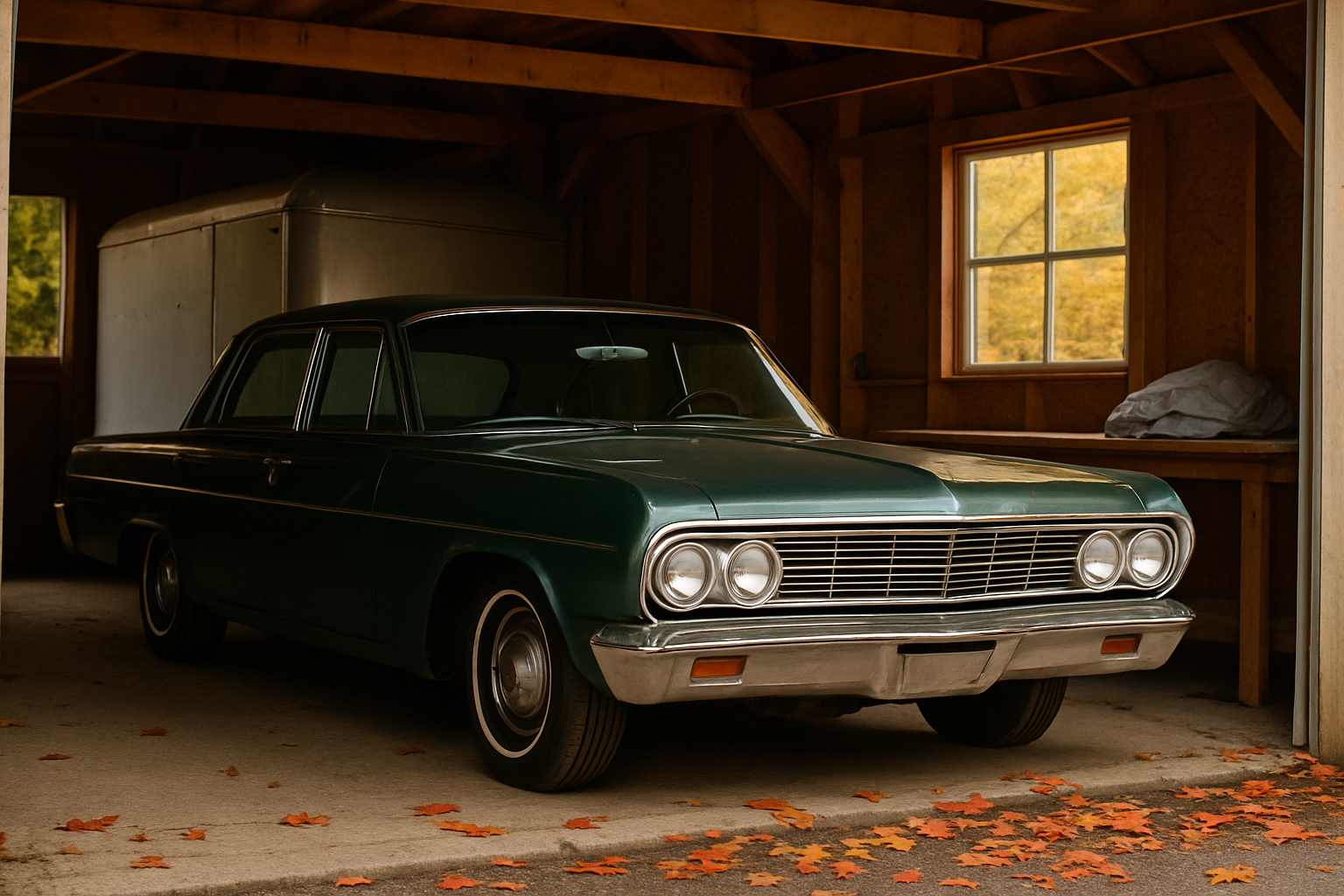
Classic Car: Insuring Winter Storage in Quebec
Last drives of the season, first freezes, salt already spreading on certain roads: by early October, it’s time to put away the classic car. Should your insurance follow the vehicle’s rhythm, or stay the same until spring? The answer depends on your contract, where you store the vehicle, and what you do with your trailer or light truck. Before touching your auto insurance, here’s how to sort things out calmly.
October in Quebec: why storage prep starts now
In most regions, October brings the first nights below freezing, then abrasives and salt on the roads. For a classic vehicle, where the metal and undercarriage are often the most fragile elements, the driving season is winding down. Car shows and exhibitions are behind us, and it’s generally at this point that you wonder if you’re paying for full coverage on a vehicle that will sleep until May.
Three questions help you figure it out: will the vehicle really drive again this fall or winter, where will it be stored, and does the value in your contract still match reality? For many owners, there are also two companions on the road: the trailer used for transport and the light truck that pulls it.
- Actual use until spring (none, occasional outings, storage with a third party)
- Storage location: private garage, shared garage, warehouse, farm shed
- Vehicle value and documents supporting it
- Trailer: who covers it, and for what damage
- Light truck: recreational use or work use
Insuring a vehicle at rest: reduce, suspend, or keep everything?
Each insurer has its own rules, and contracts for classic vehicles don’t all look the same. Some already provide for limited use and storage conditions. Others allow you to adjust protection by season. The only reliable source remains your contract and your insurer’s written response.
The general principle is simple: a vehicle that isn’t moving is no longer exposed to collisions, but it remains exposed to fire, theft, vandalism, water damage, or falling objects. These risks don’t take a winter break.
Maintain reduced coverage
This option involves keeping protections for damage outside of driving (fire, theft, vandalism, various breakdowns) while stopping driving coverage. It works well for a vehicle stored in a secure location. Ask what happens if you need to move it, even just a few kilometres to a shop, before considering this option.
Suspend coverage completely
This may seem economical, but it’s the solution that leaves the most gaps. A garage fire in January, damage caused by a structure collapsing under snow, or theft would then be your responsibility. If the vehicle has significant sentimental or financial value, this decision needs careful consideration. Also check SAAQ requirements for registration, since an active licence plate and insurance coverage aren’t managed independently of each other.
Agreed value or market value: the right time to check
For a collector vehicle, the value is rarely that of an ordinary vehicle of the same age. Several contracts provide for a value determined in advance, sometimes called agreed value, rather than a value established at the time of loss based on the market. Depending on the type of coverage, the rules differ: required documents, evaluation, limits. The details are in your policy, not in garage conversations.
Fall is ideal for updating this. The vehicle is clean after the season, and you still have maintenance and restoration invoices on hand. If you repainted it, redid the interior, changed the engine, or added rare parts this year, your insurer needs to know, because a value that’s too low would leave a gap when a loss occurs.
- Recent photos, exterior, interior, engine compartment, serial number
- Restoration, parts, and labour invoices
- Evaluation by a specialized appraiser if major changes have occurred
- List of spare parts stored with the vehicle
- Proof of ownership and current registration documents
The garage matters as much as the contract
A classic vehicle is often stored in a garage attached to or separate from the residence. This location is part of the risk: a garage fire can spread to the house, and vice versa. The products stored (gasoline, solvents, paints), battery chargers left plugged in for months, and portable heaters deserve particular attention. Your home insurance and vehicle insurance react differently depending on the origin and nature of the damage, which is why it’s worth asking each insurer what’s covered in the garage.
A few simple steps reduce both risks and unwelcome surprises in spring. Rodents love wiring and trim, moisture attacks leather and metal, and a poorly prepared fuel tank leaves deposits in the fuel system.
- Clean and dry the vehicle, then cover it with a breathable cover
- Stabilize fuel and fill the tank to limit condensation
- Disconnect or maintain the battery with a suitable maintenance charger
- Set traps or repellents for rodents, away from conduits
- Raise or move the vehicle away from areas where water can accumulate
- Install a smoke detector and lock the garage
Trailer: what’s covered, what’s not
Many classic car owners transport their vehicle on a closed or open trailer to exhibitions, a shop, or a buyer. Generally, the trailer is linked to the towing vehicle for liability, but damage to the trailer itself, its contents, and the transported vehicle are not always covered the same way. This also applies to accessories like winches, ramps, and tie-down straps.
A trailer stored over winter can also be overlooked in discussions. If it’s stored outside, it’s exposed to theft, snow, and vandalism. A separate contract or endorsement can provide protection; it’s better to ask before the first storm than after. To understand how other motorized vehicles and their trailers are treated, our guide on recreational vehicle insurance presents several comparable situations.
- Value of trailer and equipment, declared to your insurer
- Coverage for the vehicle while transported on the trailer
- Damage to trailer in case of theft, fire, or collision
- Use lent to a friend or club member
- Outdoor storage: padlock, anti-theft support, lit location
Light truck: recreational, work, and grey areas
The truck towing the trailer is sometimes itself a classic vehicle, or a recent model that serves both recreation and work. This is where a common grey area appears: a vehicle covered as a classic vehicle is under limited-use conditions. If it’s used to transport tools, materials, or clients, the insurer will see it differently, and a claim could complicate things if the declared use doesn’t match actual use.
For the entrepreneur or self-employed worker who owns an old work truck, the safest approach is to clearly declare what you use it for. Our article on commercial vehicle insurance explains the usual criteria that distinguish personal use from commercial use. And if you manage three or more vehicles, fleet insurance rules may apply.
Before cold season, take ten minutes to inventory everything that drives at your place: classic vehicle, truck, trailer, service vehicle. Note for each one the use, storage location, and value, then compare with what your latest renewal notice shows.
Returning to the road in spring
When bringing out the vehicle, restore coverage before driving, not after. Check the date coverage resumes, the licence plate, battery, tires, and brakes, then take a test drive in a quiet area. A mechanical inspection before the first outing prevents a small storage issue from becoming a claim.
Frequently asked questions
Can I cancel my classic car’s insurance during winter?
It depends on your contract and what’s provided for registration. Even if stored, a vehicle remains exposed to fire, theft, and vandalism. Ask your insurer if there’s a reduced coverage option rather than complete suspension.
Is a car stored in the garage protected against fire?
Only if the corresponding coverage is maintained in the contract. Damage caused by a garage fire can affect both the vehicle and the building, which is why it’s worth validating each policy separately.
What is agreed value?
It’s a value established in advance between you and the insurer for the vehicle. It serves as a reference in case of total loss. The conditions, such as proof and evaluations required, vary from contract to contract.
Is my trailer automatically covered with my car?
Not always, or not for all risks. Liability often follows the towing vehicle, but damage to the trailer itself and its contents may require separate coverage. Check this in writing.
Can I transport a classic car on a trailer without notifying my insurer?
It’s better to declare it. Some contracts provide conditions for transport, such as proper tie-downs or the use of a closed trailer. A quick call lets you know if everything is in order.
Can my old truck be insured as a collector vehicle?
Possibly, if its age, condition, and use meet the insurer’s criteria. A truck used for work is rarely eligible for this type of contract. Clearly declare how you use it.
What documents should I keep to prove the value of my classic vehicle?
Dated photos, restoration and parts invoices, a recent appraisal, and proof of ownership. Keep digital copies in addition to paper copies, stored outside the garage.
Do I need to modify my contract if I’ve done restoration work?
Yes, inform your insurer of any significant improvements, such as a rebuilt engine, repaint, or interior. Too low a value leaves a gap in case of loss, and undeclared changes can complicate a claim.
Storing your classic vehicle without blind spots
Good storage rests on three elements: a contract that reflects actual use, an up-to-date value, and a secure location. The trailer and light truck deserve the same review as the car itself, because that’s often where surprises appear. Take time to reread your documents, ask questions in writing, and compare options at a relaxed pace before the first snow.
On AccesDirect, you compare online offers from licensed partner brokers and agencies in your province. The service is free and without obligation.
Compare the protections offered for your vehicle before winter.
Compare auto →Also read: Auto insurance in Quebec · Home insurance in Quebec · Recreational vehicle insurance
Une seule requête
Remplissez un profil unique. On interroge les assureurs à votre place — vous ne recommencez jamais.
Sans engagement
Comparer ne vous engage à rien. Vous choisissez qui contacter — ou personne. On ne revend pas votre numéro.
Réseau pan-canadien
Auto, habitation, moto, VR. Des cabinets et courtiers partenaires licenciés partout au pays.
Le meilleur prix vous attend.
Comparez en 3 minutes. Choisissez votre couverture. Aucun rappel commercial forcé.


